
Most missed tax savings on an investment property don’t come from a forgotten receipt. They come from how the property’s costs were recorded: what went to land, what went to the building, how improvements were classified and whether shorter-lived components were ever separated out.
If you want to find savings you may be missing, start with a rental property depreciation review: check your depreciation schedule against what you actually own. The eight steps below walk you through it, give you the questions to bring to your CPA and help you decide whether a cost segregation study is worth paying for.
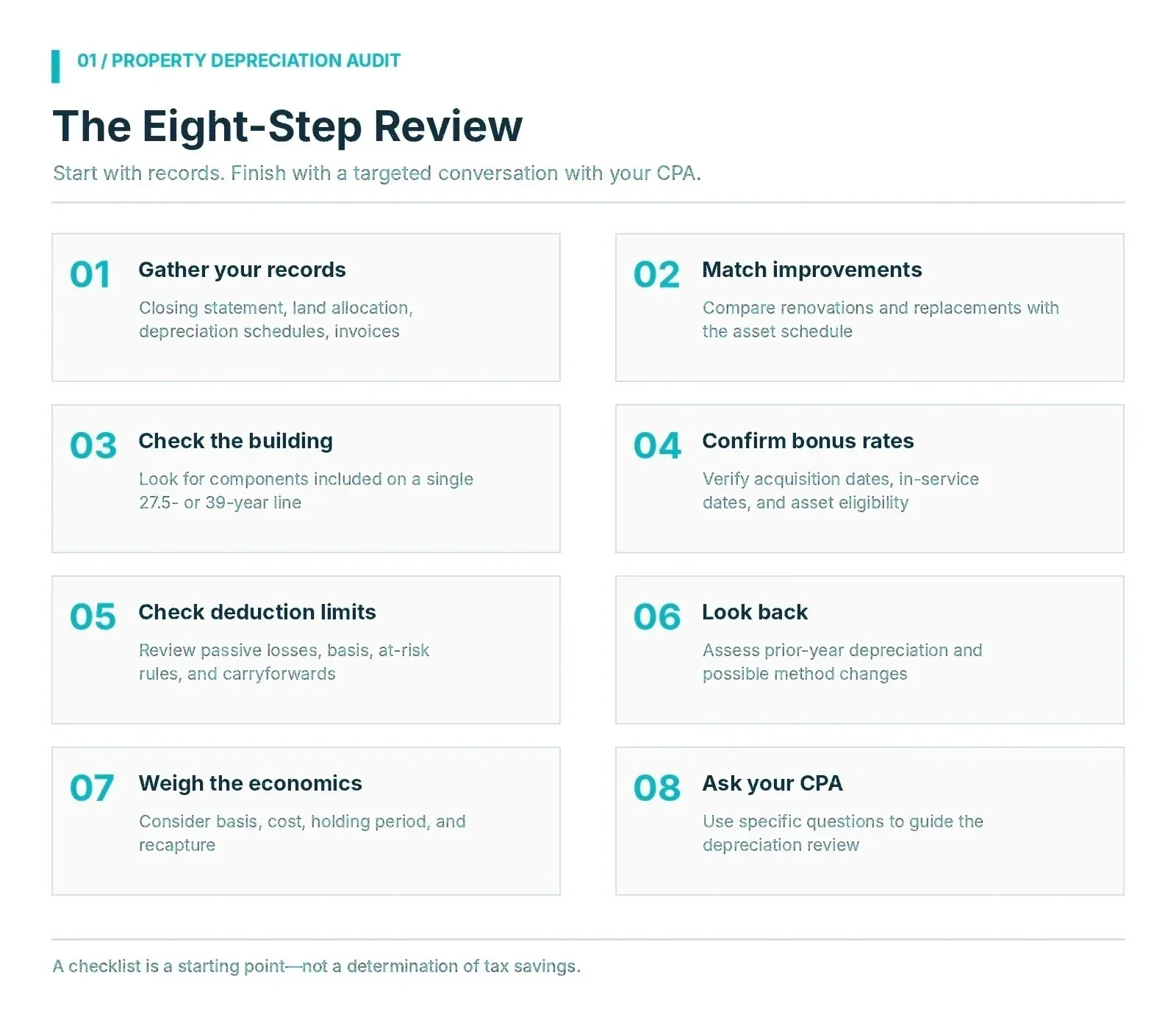
The 8-Step Depreciation Review at a Glance
| Step | What to check | Why it matters |
|---|---|---|
| 1. Gather records | Closing statement, land allocation, depreciation schedules, improvement invoices | Your purchase price is not your depreciable basis |
| 2. Match improvements | Every renovation and replacement against the schedule | Omitted or misclassified projects are common |
| 3. Check the building | Whether the whole building sits on one 27.5- or 39-year line | Shorter-lived components may never have been separated |
| 4. Confirm bonus rates | Acquisition and placed-in-service dates | The date decides whether 100%, 40% or 20% bonus applies |
| 5. Check limits | Passive losses, suspended losses, basis and at-risk limits | More depreciation only helps if you can use it |
| 6. Look back | Properties bought in earlier years | Missed depreciation can often be caught up without amending returns |
| 7. Weigh the economics | Basis, hold period, study cost, recapture | Some properties don’t justify a study |
| 8. Ask your CPA | Eight specific questions | Specific questions get useful answers |
Step 1: Gather the Records That Show Your Property’s Tax Basis
Before you can find missed savings, you need a clear picture of your property’s tax basis and history. Start with these documents:
- Closing statement or settlement documents from the purchase
- How the purchase price was split between land and building
- Your current depreciation schedule, plus prior years’ schedules if available
- Renovation, construction and replacement invoices
- Records of appliances, equipment, furniture and other assets you bought
- The property tax assessment (often used to estimate the land split)
- Your last two to three tax returns, including the rental schedules
If the property is held through a partnership or other entity, you may need the entity’s records too.
Why this matters: the purchase price you remember is not the same as the property’s adjusted tax basis. Certain acquisition costs are added to basis. Land is not depreciable. Later improvements increase basis, and depreciation you were allowed to take reduces it.
Question for your CPA: Does my depreciation schedule reflect the property’s original basis, the land allocation and every adjustment since?
Step 2: Check How Improvements and Repairs Were Recorded
List the work you’ve done since you bought the property: a resurfaced parking lot, renovated units, new flooring, a replaced roof, new equipment, tenant improvements. Then check how each project was recorded.
Some costs may be deductible repairs. Others are capital improvements. Some components of an improvement may qualify for shorter recovery periods. The correct treatment depends on the work done and the IRS rules that apply to it.
| Project | What to verify |
|---|---|
| Major renovation | Was it capitalized and depreciated, or missing from the schedule entirely? |
| Parking lots, landscaping, fencing | Were qualifying land improvements given a 15-year life rather than lumped into the building? |
| Appliances, equipment, furniture | Were they recorded as separate shorter-life assets? |
| Interior improvements to a commercial building | Were qualifying interior improvements treated as 15-year qualified improvement property rather than 39-year building? |
| Replaced components (roof, HVAC, windows) | Was the remaining value of the old component written off, or is it still being depreciated? |
| Repairs and maintenance | Were deductible repairs separated from capital improvements? |
That last row is one of the most commonly missed items. When you replace a component, you may be able to write off the remaining value of the old one through a partial asset disposition instead of depreciating two roofs at once. A cost segregation study can help identify those amounts.
You’re not deciding the tax treatment yourself. You’re flagging projects that deserve a closer look.
Question for your CPA: Are any improvement costs omitted, misclassified or assigned the wrong recovery period, and did we write off the old components we replaced?
Step 3: Check Whether Your Building Was Depreciated as One Asset
If your entire building basis sits on a single 27.5-year (residential rental) or 39-year (commercial) line, shorter-lived components may never have been separated out. That’s where most unfamiliar opportunities appear.
A cost segregation study identifies parts of a building that qualify for 5-, 7- or 15-year recovery periods instead of 27.5 or 39 years. Typical examples include certain appliances, carpeting, cabinetry, specialty electrical and plumbing, and land improvements such as paving, landscaping and site lighting.
The mix varies by property type. A hotel may carry substantial furniture and equipment. A retail center may have significant parking and site work. A multifamily property may have appliances, flooring and other separately depreciable components. See which property types tend to have the most reclassifiable components for more.
Illustrative Example: A $1 Million Commercial Property
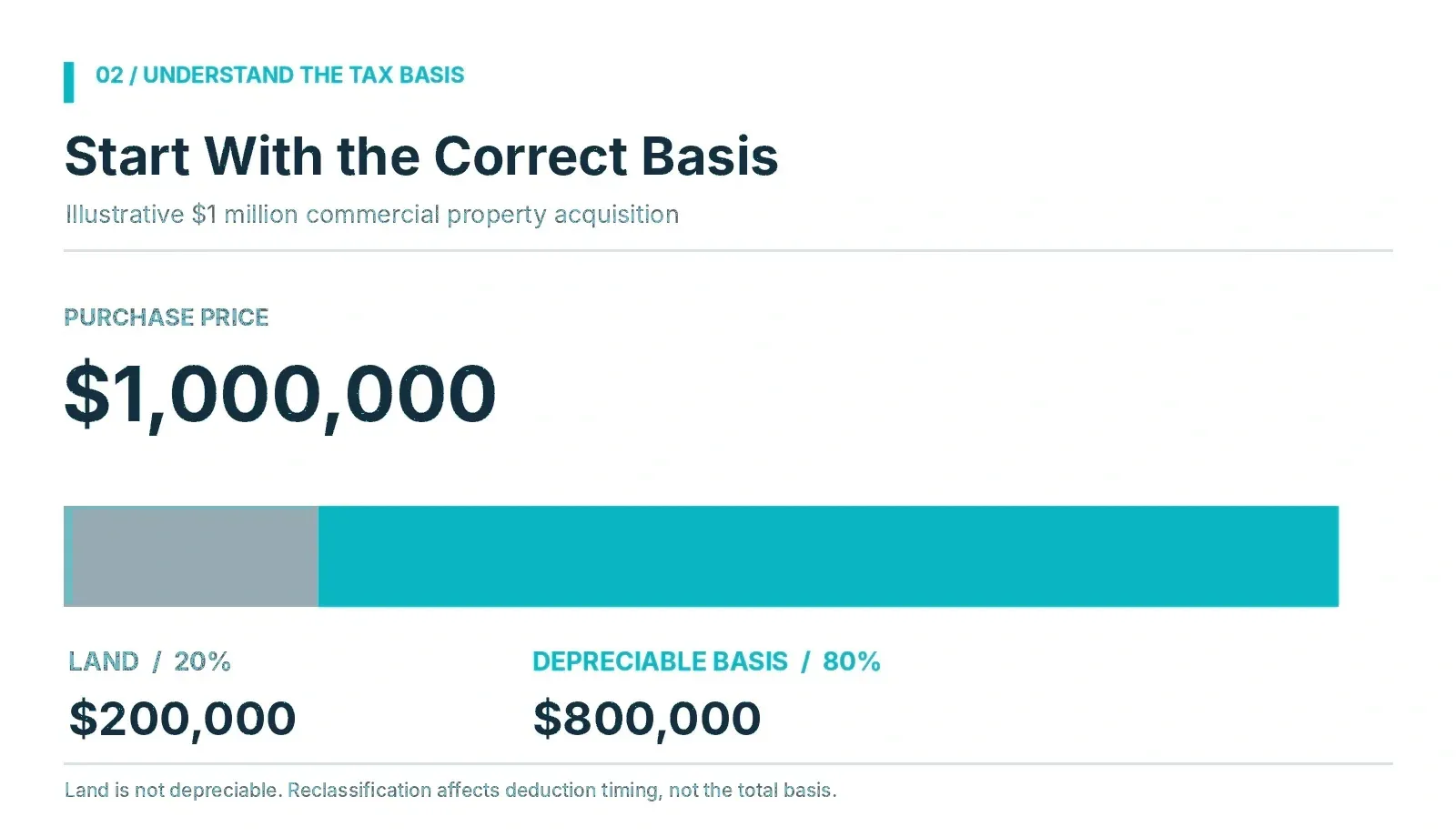
Suppose an investor buys a commercial property for $1 million, and $200,000 is properly allocated to land. That leaves $800,000 of depreciable basis. If all $800,000 is on the schedule as 39-year building, the owner deducts roughly $20,500 a year on a straight-line basis (less in the first year).
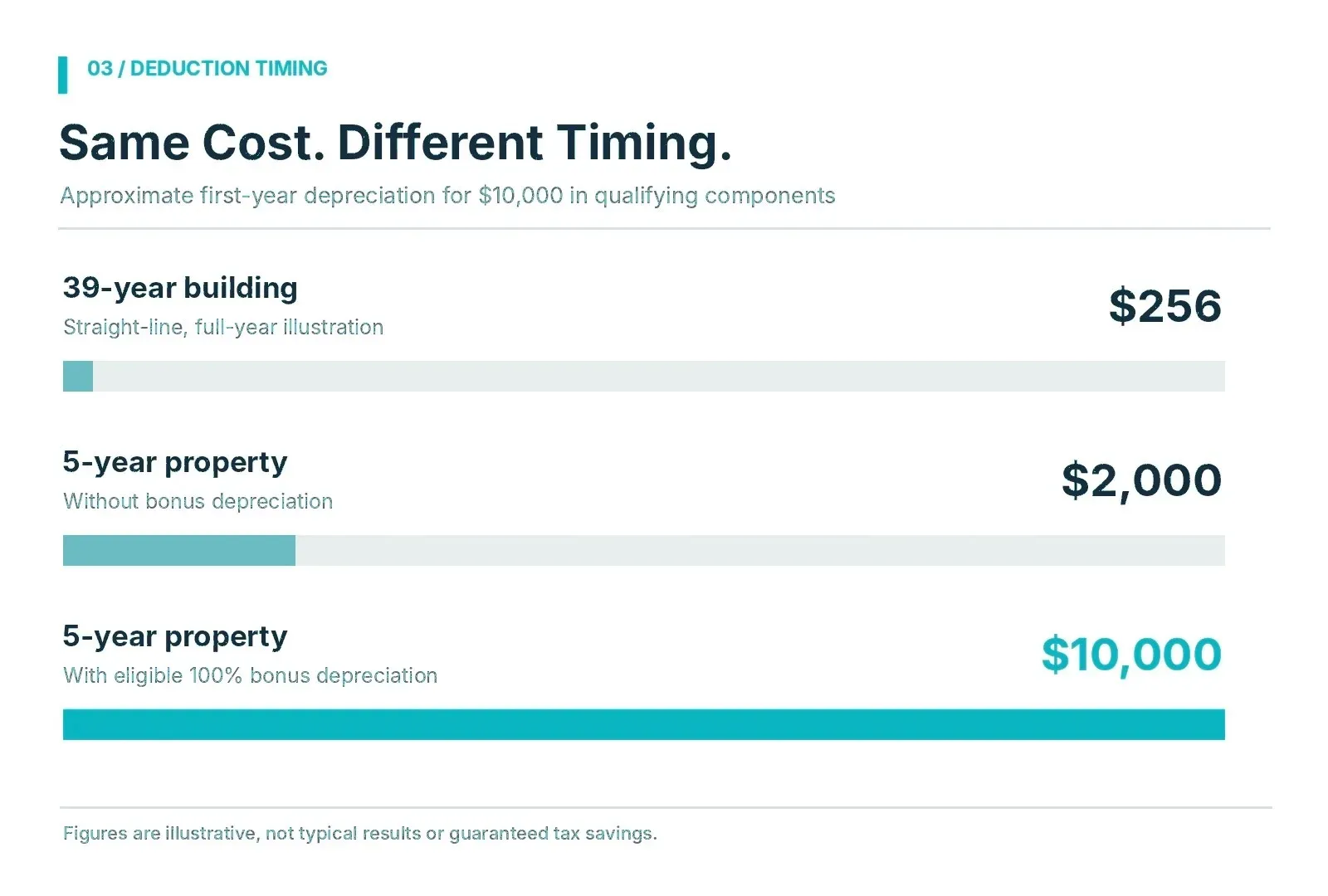
That may be correct. But it doesn’t show whether anyone checked for shorter-lived components. Here’s what moving each $10,000 of qualifying components to 5-year property could do to the first-year deduction:
| How $10,000 of components is depreciated | Approximate first-year deduction |
|---|---|
| 39-year building (straight-line, full year) | About $256 |
| 5-year property, no bonus depreciation | About $2,000 |
| 5-year property with 100% bonus depreciation | $10,000 |
Illustrative only. These figures show how recovery periods change timing; they are not a typical or expected result for any property.
Two things a study does not do: it doesn’t increase your total $800,000 basis, and it doesn’t guarantee tax savings. It changes when you can deduct that basis. Whether earlier deductions reduce your tax this year depends on your own tax situation (Step 5).
Question for your CPA: Was a component-level review done when this property was bought or built?
Step 4: Confirm Which Bonus Depreciation Rate Applies
Your bonus depreciation rate depends on when the property was acquired and when it was placed in service. The One Big Beautiful Bill Act, signed July 4, 2025, permanently restored 100% bonus depreciation for qualifying property with a recovery period of 20 years or less that was acquired and placed in service after January 19, 2025. Property acquired before January 20, 2025 stays on the old phase-down.
| Acquired (generally the binding contract date) | Placed in service | Bonus rate for qualifying components |
|---|---|---|
| After January 19, 2025 | After January 19, 2025 | 100% |
| Before January 20, 2025 | During 2025 | 40% |
| Before January 20, 2025 | During 2026 | 20% |
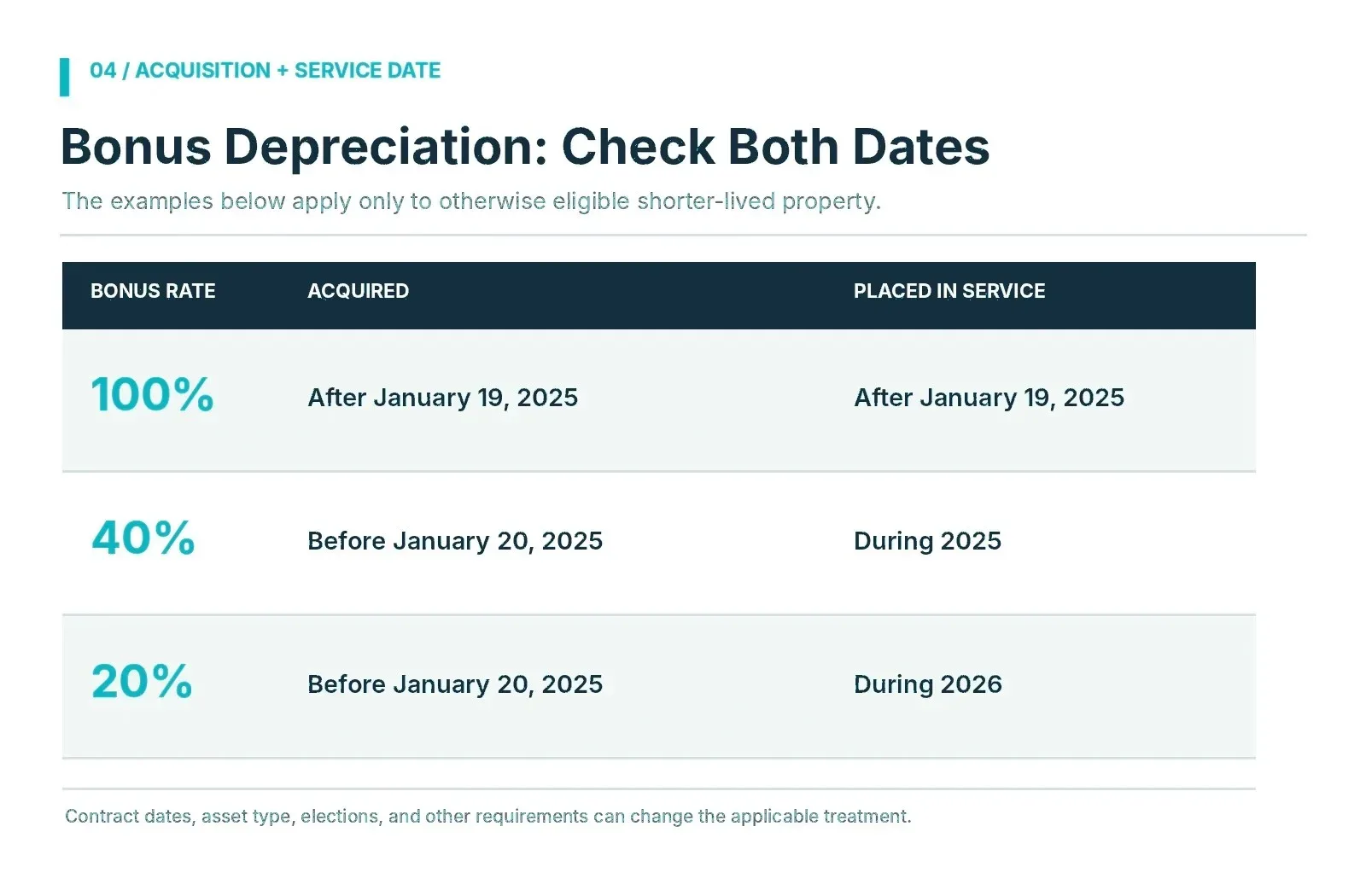
Bonus depreciation applies to qualifying shorter-lived components, not to the building itself, which keeps its 27.5- or 39-year recovery period. Buying in 2025 doesn’t automatically mean everything qualifies for 100%: binding contract dates, placed-in-service dates, asset types and elections can all change the result.
For a deeper look at the new rules, read our guide to OBBBA 100% bonus depreciation. The IRS rules on recovery periods and bonus depreciation are in IRS Publication 946, How to Depreciate Property.
Question for your CPA: Have the acquisition and placed-in-service dates been verified for every asset on my schedule?
Step 5: Check Whether Your Deductions Are Limited or Carried Forward
Finding more depreciation only saves tax if you can use it. Rental losses are generally passive, which means they can only offset passive income unless an exception applies. Losses you can’t use this year are typically suspended and carried forward to later years or until you sell the property.
The main exceptions are:
- The $25,000 special allowance for owners who actively participate, which phases out between $100,000 and $150,000 of modified adjusted gross income.
- Real estate professional status, which requires 750+ hours and more than half of your working time in real property trades, plus material participation.
- Short-term rentals with an average guest stay of 7 days or less, where material participation may let losses offset other income. See how the short-term rental strategy works.
Basis and at-risk limits can also restrict deductions, especially for property held through a partnership.
If you’ve owned rentals for several years, you may already have suspended losses on your return. That isn’t a missing deduction, but it is part of your tax position. The IRS explains these rules in Publication 925, Passive Activity and At-Risk Rules.
Question for your CPA: Do I have suspended passive losses, and when could I use them or any new depreciation?
Step 6: Review Properties You Bought in Earlier Years
Depreciation you missed in earlier years isn’t necessarily lost. If a property was depreciated using an incorrect method, you can often catch up the difference in the current year by filing Form 3115 for a change in accounting method, with a Section 481(a) adjustment, rather than amending every prior return.
That’s how a look-back cost segregation study works: components of a building you already own are reclassified, and the extra depreciation you would have claimed is generally taken in the year of change.
The procedure has detailed eligibility requirements. Not every depreciation error is an accounting method change, and an older property doesn’t automatically qualify for today’s 100% bonus rate; the rate depends on when it was acquired and placed in service.
The IRS form and instructions are at About Form 3115, Application for Change in Accounting Method.
Question for your CPA: Is my property’s depreciation method correct, and would a look-back study or accounting method review be worthwhile?
Step 7: Decide Whether a Cost Segregation Study Is Worth It
Finding a possible issue doesn’t automatically mean you should order a study. First, check whether the potential benefit justifies the cost. Factors include:
- The property’s depreciable basis and the likely amount of qualifying components
- When the property was acquired and placed in service
- Depreciation already claimed
- Whether you can use the deductions (Step 5)
- How long you plan to hold the property
- The cost of the study
- Depreciation recapture when you sell
On cost: TDA studies start at $650 for residential and $1,250 for commercial properties, and the cost of a study is generally tax deductible.
On recapture: when you sell, depreciation may be recaptured. Reclassified personal property is recaptured as ordinary income, and building depreciation is taxed at up to 25%. A 1031 exchange can defer recapture, and the value of taking deductions earlier often outweighs tax paid later, but your CPA should model it for your situation.
For some properties the acceleration is meaningful. For others, the cost of a study outweighs the benefit, and a good feasibility review should tell you that before you pay for anything.
Step 8: Questions to Ask Your CPA About Your Property’s Depreciation
“Can you save me more on taxes?” is hard to answer without reviewing your whole financial picture. Specific questions get faster, more useful answers:
- Are all of my property’s depreciable assets on the schedule?
- How was the land value determined, and is the split reasonable?
- Have major improvements been classified correctly, and were replaced components written off?
- Were shorter-lived components considered when I bought or built the property?
- Which assets qualify for bonus depreciation, and at what rate?
- Could the passive activity rules stop me from using more deductions?
- Would a look-back cost segregation study be appropriate?
- How would faster depreciation affect my taxes when I sell?
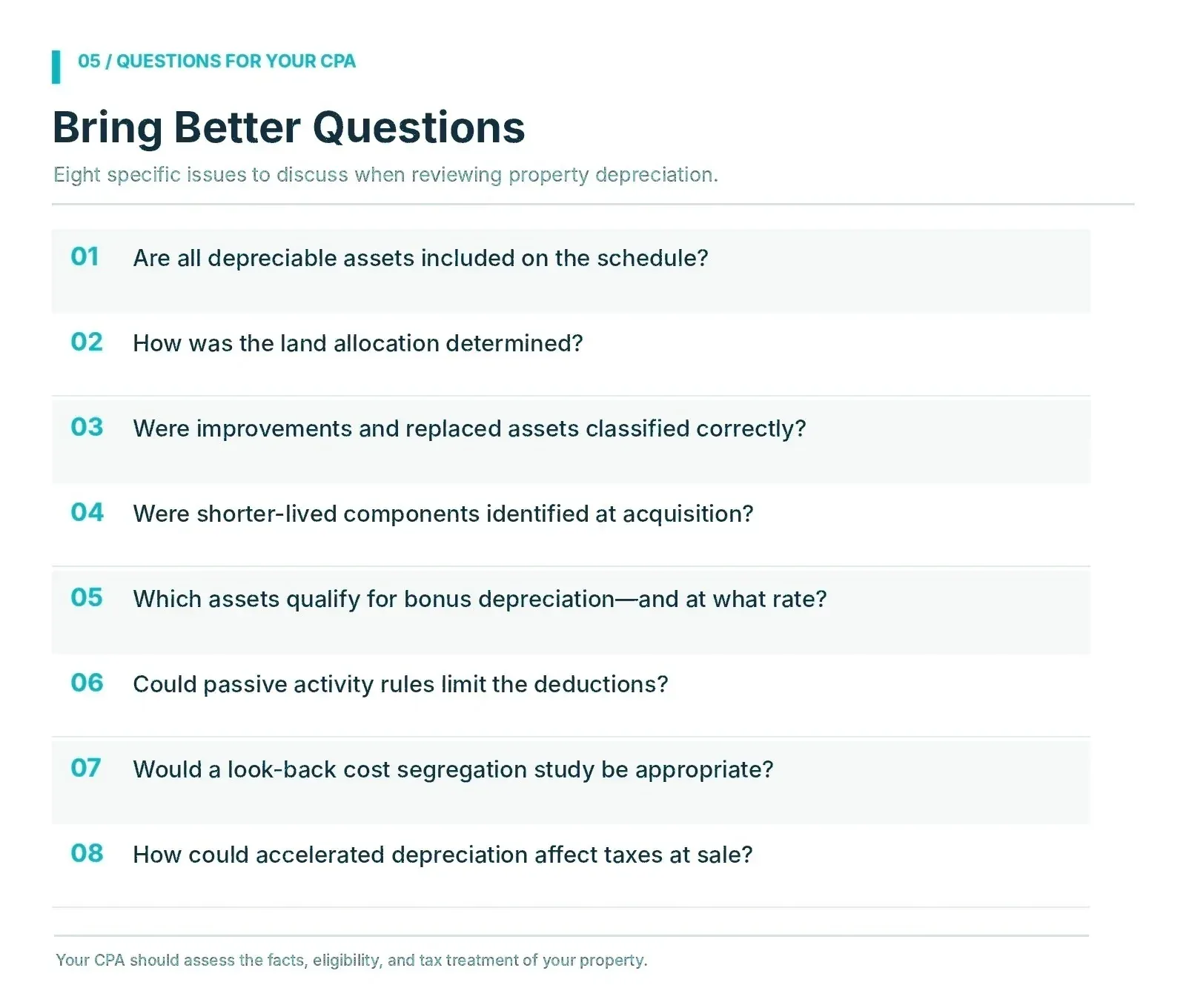
These give your CPA a clear starting point, and many of them can be answered quickly from your existing schedule.
Signs Your Property Needs a Closer Depreciation Review
No single test proves you’ve missed deductions. But a closer look may be worthwhile if:
- You’ve owned a substantial property for years without a cost segregation review.
- You’ve completed significant improvements that were never reviewed for tax classification.
- Nearly all of the purchase price was assigned to the building, with no component-level analysis.
- The property came with significant equipment, furnishings or site improvements.
- You own several properties and the depreciation records are inconsistent.
- You changed CPAs or tax software and the schedule didn’t carry over cleanly.
- Your CPA has flagged a possible classification or accounting method issue.
None of these guarantees savings. They’re signals that a more detailed review may be useful.
Frequently Asked Questions
How do I know if I’m missing depreciation on my rental property?
Compare four things: your closing statement, your current depreciation schedule, your improvement invoices and your last two tax returns. Red flags include the whole purchase price sitting in one building line, renovations that never appear on the schedule, and no record of land allocation. Your CPA can confirm whether anything was omitted or misclassified.
Can I claim depreciation I missed in prior years?
Often, yes. When an incorrect depreciation method has been used on at least two consecutive returns, the catch-up is usually claimed in the current year by filing Form 3115 for a change in accounting method, rather than amending each prior return. If only one return is affected, an amended return may be the correct fix instead.
Can a cost segregation study be done years after purchase?
Yes, in many cases. A look-back study reclassifies components of a building you already own, and the depreciation you would have claimed under the shorter recovery periods can generally be caught up through Form 3115. The bonus rate, if any, depends on when the property was acquired and placed in service, not when the study is done.
What happens if I never claimed depreciation on my rental?
Your basis is generally still reduced by the depreciation you were allowed to claim, even if you never claimed it. That means you can face tax on depreciation at sale without ever having received the deduction. This is one of the main reasons to review an older rental’s depreciation schedule before you sell.
Is a cost segregation study worth it for a smaller rental property?
Sometimes. It depends on the depreciable basis, how long you plan to hold the property, whether you can actually use the deductions under the passive loss rules, and the cost of the study. For some properties the benefit is meaningful; for others it is not, and a feasibility review should say so before you pay for anything.
Does the free calculator tell me exactly what I’ll save?
No. The calculator gives a preliminary estimate based on the property details you enter and standard assumptions. Your actual deductions depend on an engineering-based study of the building’s components, and your actual tax savings depend on your own tax situation, which your CPA needs to review.
See What a Cost Segregation Study Could Change for Your Property
Finding missed tax savings starts with understanding what you own, how its costs were recorded and whether your depreciation schedule deserves another look. TDA prepares engineering-based cost segregation studies for owners of income-producing property in all 50 states, and we work alongside your CPA.
Free feasibility review and quote
Tell us about your property and we’ll tell you whether a study is likely to be worth it.
Want a quick number first?
Try the free estimate calculator →
Calculator figures are preliminary estimates and do not guarantee deductions or tax savings. Actual outcomes depend on property characteristics, tax rules and the owner’s circumstances.
Have questions? Call 888-790-8595.
General information only — not tax, legal or financial advice. Tax outcomes depend on your individual circumstances and property, and any figures shown are illustrative estimates, not guarantees. Speak with your CPA or tax adviser before acting on any of this information.