

If you own investment real estate and haven’t filed your extended 2025 federal income tax return, October 15, 2026 is approaching fast.
Before filing, there’s one area worth reviewing with your CPA: depreciation on your investment properties.
For owners of apartment buildings, warehouses, shopping centers, offices, hotels, self-storage facilities and rental homes, depreciation can represent a substantial tax deduction. Yet some property owners may be recovering certain costs over a longer period than necessary.
With changes to bonus depreciation taking effect in 2025, now is a particularly relevant time to review how your investment property assets are classified.
Here’s what to know before the filing deadline.
What Is the October 15, 2026 Tax Deadline?
October 15, 2026 is the extended federal income tax filing deadline for most individuals who properly requested an extension for their 2025 returns.
The regular filing deadline was April 15, 2026. Taxpayers who obtained a valid six-month extension generally have until October 15 to file.
There is an important distinction: an extension to file is not an extension to pay. Taxes owed for 2025 were generally due April 15, and interest or penalties may apply to unpaid balances.
Not every investment property owner has the same filing deadline. Partnerships, S corporations and other entities generally follow different rules. Certain taxpayers also qualify for disaster-related or other special extensions.
If your individual return remains on extension, this is an appropriate time to check whether your property’s depreciation has been properly evaluated.
Source: IRS 2025 Form 1040 Filing Dates
Could You Be Missing Investment Property Depreciation Deductions?
Most property owners understand that mortgage interest, qualifying repairs, insurance and operating expenses may be deductible.
Depreciation is different. It allows you to recover the cost of eligible income-producing property over time.
Residential rental buildings are generally depreciated over 27.5 years. Most non-residential buildings are depreciated over 39 years.
However, not every asset associated with a property must follow the building’s recovery period.
Certain appliances, equipment, fixtures and land improvements may qualify for shorter depreciation periods, commonly 5, 7 or 15 years.
Identifying those assets can accelerate deductions that might otherwise be spread over decades.
Where Cost Segregation Comes In
A cost segregation study examines a property’s components to determine which assets qualify for shorter tax depreciation periods.
An engineering-based study can evaluate building information, acquisition records, improvements and supporting costs to document the appropriate asset classifications.
For example, depending on the property, qualifying assets may include:
- Appliances and certain flooring in apartment buildings
- Parking improvements and fencing at retail centers
- Certain specialized equipment in industrial properties
- Furniture and qualifying fixtures in hotels
- Gates, paving and certain equipment at self-storage facilities
Not every item automatically qualifies. Its function, ownership, use and applicable tax classification determine the treatment.
The potential benefit is accelerated depreciation, which may improve cash flow when the associated deductions are currently usable.
Why Are the 2025 Bonus Depreciation Rules Important?
Federal legislation enacted in July 2025 restored 100% bonus depreciation for certain qualifying property acquired and placed in service after January 19, 2025.
For certain qualifying assets acquired before January 20, 2025 and placed in service during 2025, the generally applicable bonus depreciation rate is 40%.
These rules can make a meaningful difference in the timing of deductions.
A building depreciated over 27.5 or 39 years generally does not qualify for standard bonus depreciation. However, certain shorter-lived assets identified through cost segregation may qualify.
Eligibility depends on the acquisition and placed-in-service dates, asset classification, applicable elections and other statutory requirements.
The acquisition date is particularly important because binding contract rules can affect when property is considered acquired.
If you acquired or improved investment property during 2025, your CPA should verify which depreciation provisions apply.
Source: IRS Publication 946, How to Depreciate Property
Which Investment Properties Should Be Reviewed?
Cost segregation isn’t limited to residential rental properties.
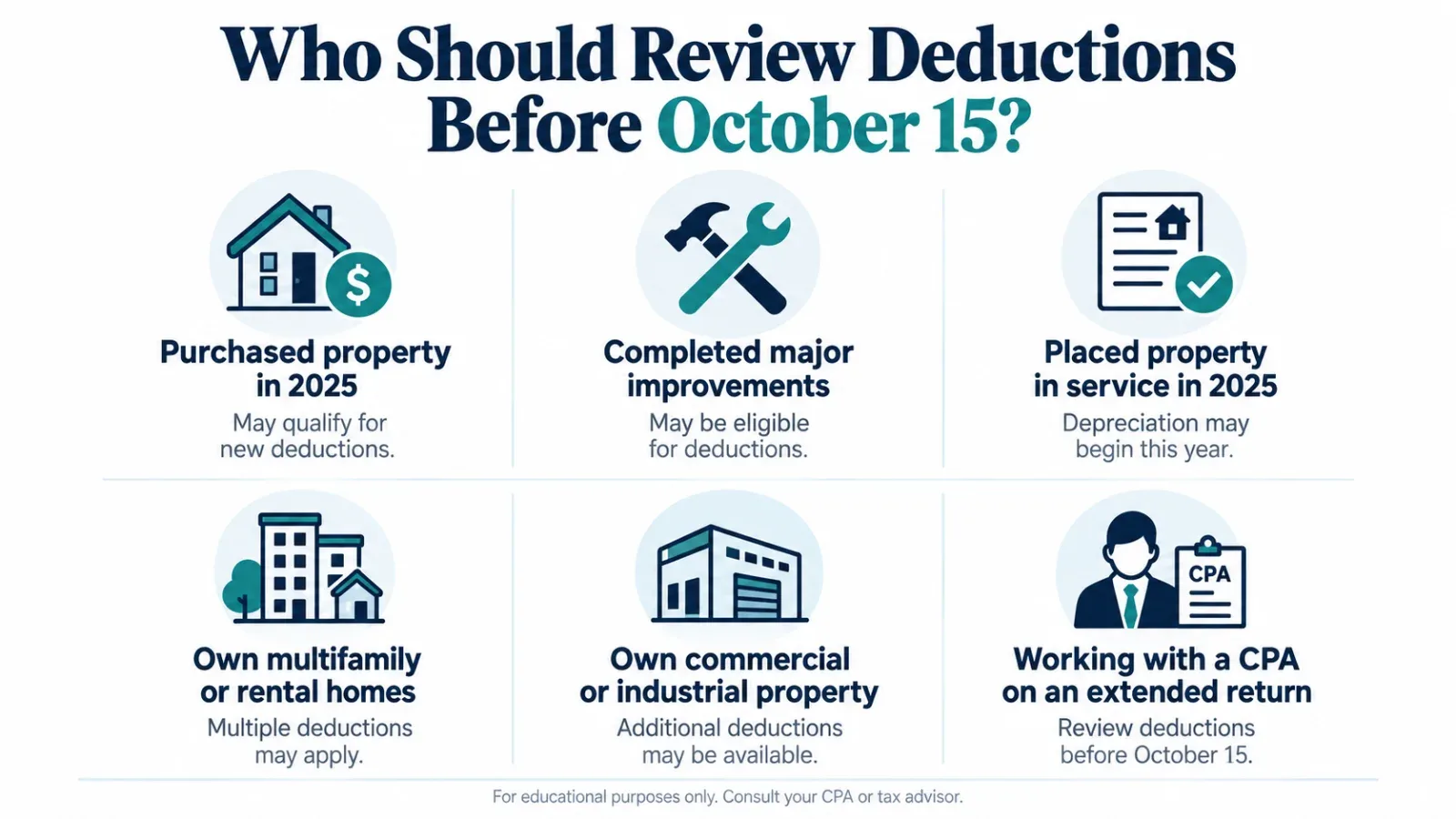
A depreciation review may be relevant to owners of:
| Property Type | Examples of Assets Worth Evaluating |
|---|---|
| Multifamily properties | Appliances, eligible flooring, site improvements |
| Office buildings | Qualifying fixtures, equipment, land improvements |
| Shopping centers | Parking areas, fencing, certain tenant improvements |
| Warehouses | Specialized equipment and qualifying site improvements |
| Hotels | Furniture, fixtures, equipment and outdoor improvements |
| Self-storage facilities | Gates, paving, fencing and qualifying equipment |
| Rental homes | Appliances, eligible flooring and land improvements |
These are potential areas for analysis, not guaranteed reclassifications.
The value of a study depends on the property’s depreciable basis, characteristics and the owner’s tax circumstances.
Five Questions to Ask Before Filing Your 2025 Return
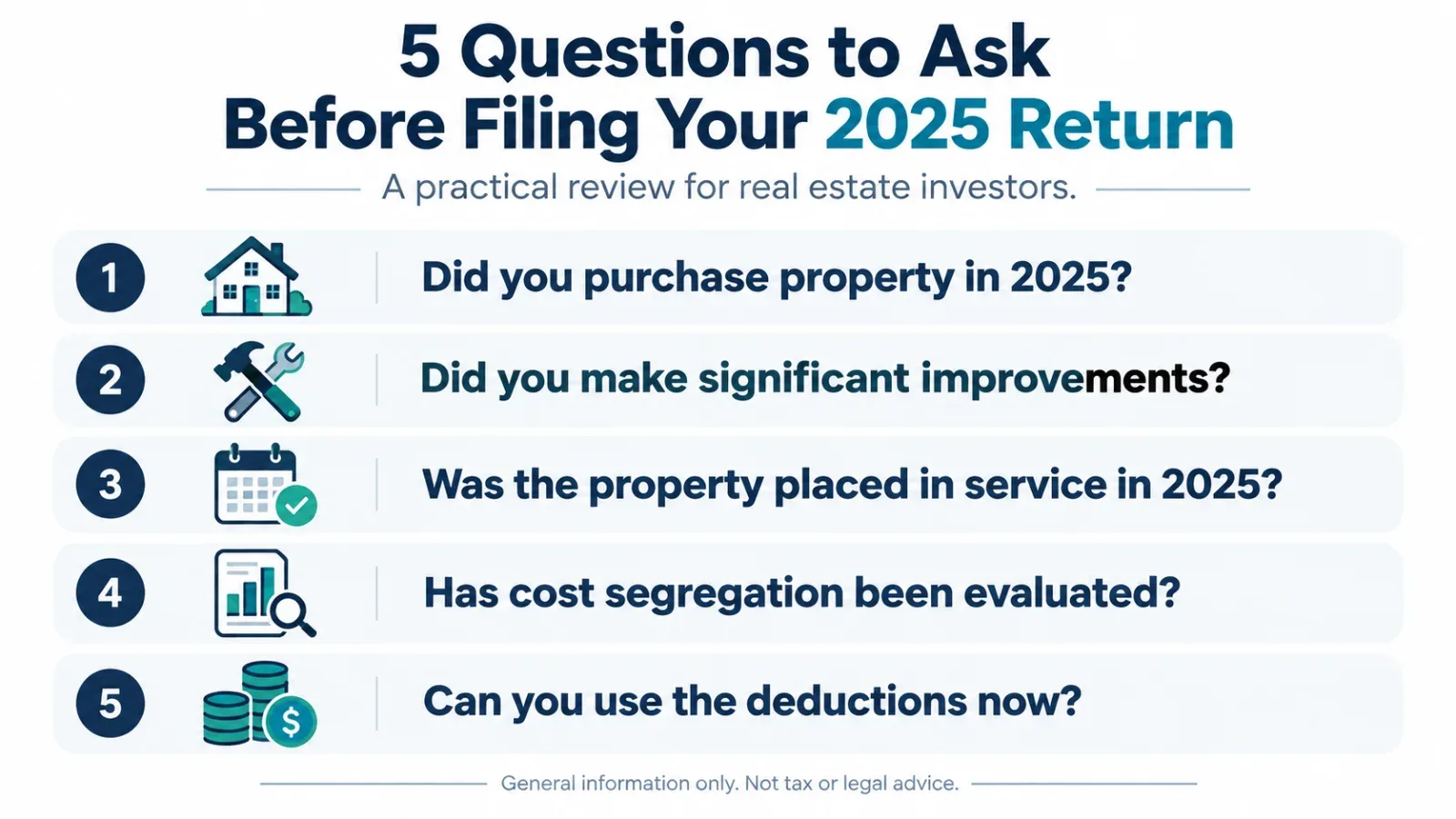
1. Did You Purchase Investment Property in 2025?
Review the purchase price allocation between land, buildings and other assets. Land is not depreciable, and the acquisition price alone does not determine the eligible deduction.
2. Did You Make Significant Improvements?
Renovations, building improvements and site work may create additional depreciable assets. Their treatment depends on whether the expenditures qualify as repairs, capital improvements or separately depreciable property.
3. Was the Property Placed in Service in 2025?
Depreciation generally begins when the property is ready and available for its intended use, which may differ from the purchase or construction completion date.
4. Has Cost Segregation Been Evaluated?
If all depreciable acquisition costs were assigned to a 27.5- or 39-year building category, ask whether qualifying shorter-lived assets were properly considered.
5. Can You Use the Deductions Now?
Accelerated depreciation doesn’t automatically translate into an immediate tax reduction.
Passive activity loss limitations and other restrictions can affect whether deductions offset current income or are carried forward.
Your CPA can help determine the actual benefit.
Is October 15 the Deadline to Complete a Cost Segregation Study?
No. October 15 is not a universal deadline for cost segregation.
Property owners may be able to complete a study after the original filing year. In certain circumstances, an accounting method change can address previously missed depreciation.
However, the appropriate tax reporting procedure depends on the property’s history and the taxpayer’s circumstances.
If your return is still on extension, ask your CPA whether evaluating cost segregation before filing makes sense and what options remain if a study cannot be completed in time.
Frequently Asked Questions
Can I Still Claim Investment Property Deductions Before October 15?
If your 2025 return is properly extended and has not been filed, eligible deductions can generally be reported on that return, subject to the applicable requirements.
Does 100% Bonus Depreciation Apply to All Investment Properties?
No. Certain qualifying assets may be eligible, but most residential and commercial buildings themselves do not qualify for standard bonus depreciation.
Can Cost Segregation Reduce Taxes on My W-2 Income?
Not automatically. Rental losses are generally passive, and exceptions depend on the taxpayer’s circumstances. A CPA should evaluate whether the deductions can offset nonpassive income.
Can I Use Cost Segregation on Property I Bought Years Ago?
Potentially. A look-back study may identify previously missed asset classifications. The original depreciation history determines which tax procedures and rules apply.
See What Cost Segregation Could Mean for Your Property
The October 15 filing deadline is approaching, but you don’t need to guess whether accelerated depreciation could benefit your investment.
TDA offers two free ways to explore your property’s potential.
Start With the Free Cost Segregation Calculator
Enter your property’s details to see an estimated range of accelerated depreciation and potential tax savings.
Calculate Your Potential Tax Savings for Free →
Get a Free, No-Obligation Quote
Want a property-specific evaluation? Submit your property information and TDA can provide a preliminary feasibility review and quote.
Request Your Free Cost Segregation Quote →
Prefer to speak with someone? Call TDA at 888-790-8595.
Calculator figures are preliminary estimates and do not guarantee deductions or tax savings. Actual outcomes depend on property characteristics, tax rules and the owner’s circumstances.
Tax disclaimer: General information only — not tax, legal or financial advice. Tax outcomes depend on your individual circumstances and property, and any figures shown are illustrative estimates, not guarantees. Speak with your CPA or tax adviser before acting on any of this information.