
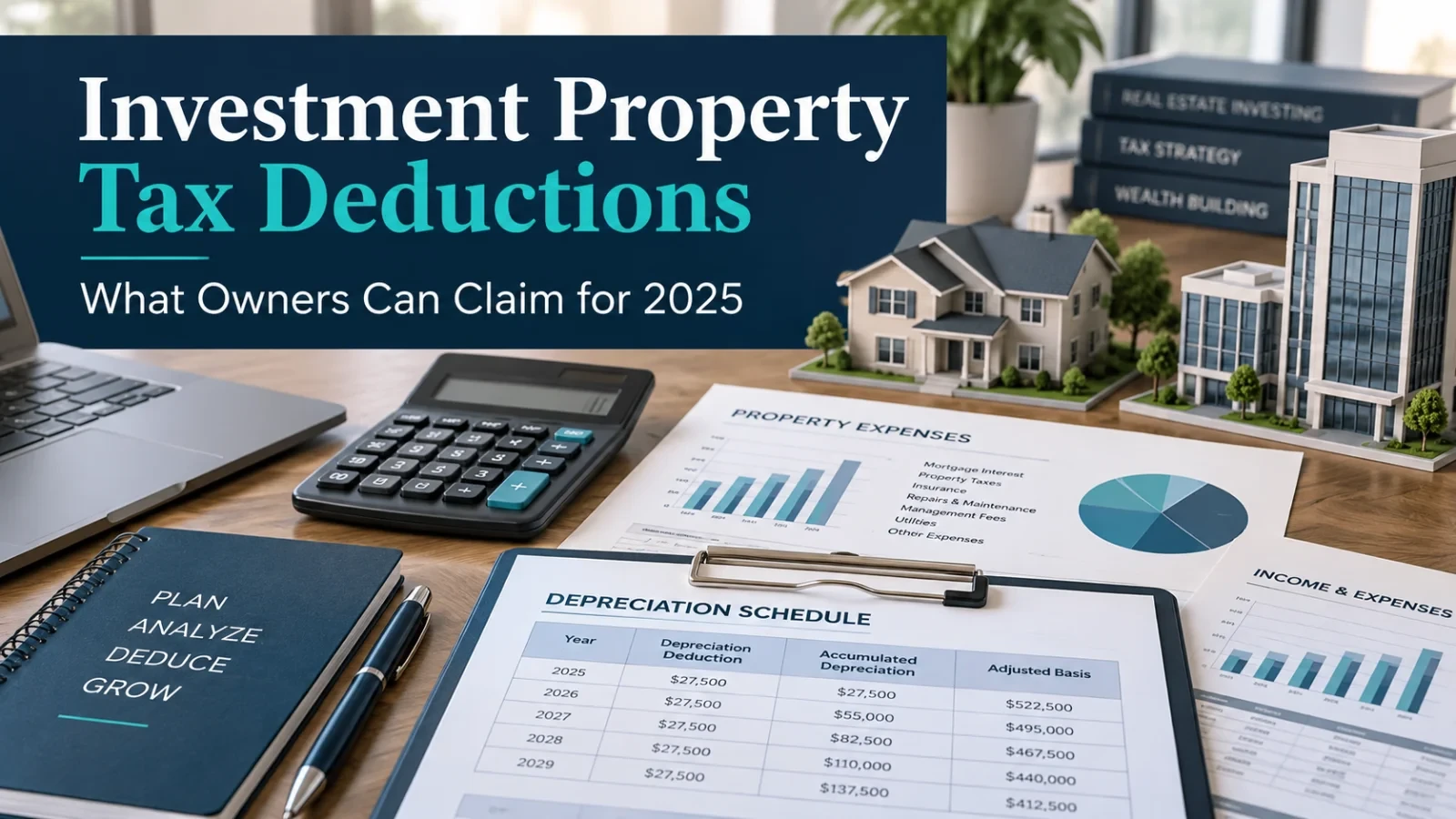
Owning investment property involves more than collecting income and paying expenses. From mortgage interest and property taxes to building improvements and depreciation, several costs may affect how much federal income tax you owe.
But not every expense is treated the same way.
Some costs can be deducted currently. Others must be capitalized and recovered over several years. And certain property components may qualify for accelerated depreciation through cost segregation.
If you’re preparing your 2025 taxes, understanding these differences can help you ask better questions, avoid overlooking eligible deductions and make informed decisions with your CPA.
What Expenses Can You Deduct on Investment Property?
Investment property owners may be eligible to deduct ordinary and necessary expenses connected with operating an income-producing property or business.
The exact treatment depends on the property, how it is used, the taxpayer’s accounting method and applicable federal tax rules.
Here are the categories worth reviewing.
1. Mortgage Interest and Financing Expenses
Interest paid on qualifying investment property loans may be deductible, subject to applicable limitations.
For example, a property owner financing an apartment building or warehouse may be able to deduct eligible mortgage interest associated with that activity.
However, paying down the loan principal does not create the same deduction.
Certain loan costs may also need to be amortized rather than deducted immediately.
2. Real Estate Property Taxes
Eligible real estate taxes associated with income-producing property may be deductible.
Special assessments, taxes incurred during construction and certain other charges can have different treatment, so it’s important to distinguish deductible taxes from costs that must be capitalized.
3. Repairs and Maintenance
Routine expenses that keep property in ordinarily efficient operating condition may qualify for current deductions.
Examples can include fixing a leaking pipe, repairing a damaged door or performing routine maintenance.
A major renovation or replacement of an entire building system can be different.
Under federal tax rules, expenditures that improve, restore or adapt property to a new use may need to be capitalized.
The distinction between a repair and an improvement can significantly affect when a deduction becomes available.
4. Insurance and Property Management
Qualifying insurance premiums, property management fees, maintenance contracts, utilities and other operating expenses may be deductible when connected with the investment activity.
Documentation and the business purpose of each expense matter.
5. Professional and Administrative Expenses
Accounting fees, certain legal fees, advertising, bookkeeping and other qualifying administrative costs may be deductible.
However, costs directly associated with acquiring or selling property, obtaining financing or completing improvements may require capitalization or separate treatment.
6. Depreciation
Depreciation allows owners to recover the cost of eligible income-producing assets over time.
For investors with substantial real estate holdings, depreciation can represent a significant portion of the deductions associated with property ownership.
It is also one of the categories most affected by asset classification.
How Does Investment Property Depreciation Work?
Federal tax depreciation depends on the type of asset.
| Property or Asset | Typical Recovery Period |
|---|---|
| Residential rental building | 27.5 years |
| Non-residential commercial building | 39 years |
| Certain qualifying personal property | 5 or 7 years |
| Certain qualifying land improvements | 15 years |
| Land | Not depreciable |
These periods are general examples under the applicable depreciation system. Specific assets and taxpayer elections can receive different treatment.
For instance, a commercial property might include a building, parking improvements, furniture, machinery and other components.
Those items do not necessarily share the same depreciation recovery period.
This is why a detailed review of property costs can be valuable.
What Is Cost Segregation?
Cost segregation is a process that identifies qualifying property components eligible for shorter tax depreciation periods.
A study analyzes relevant building information and costs to determine whether certain assets should be classified separately from the building itself.
Consider an apartment complex.
The building structure is generally depreciated over 27.5 years. But certain qualifying appliances, carpeting and land improvements may have shorter recovery periods.
A hotel may include significant furniture and equipment. A warehouse may have specialized equipment. A shopping center may include separately depreciable parking and site improvements.
An engineering-based cost segregation study can help document the appropriate classifications.
The benefit is primarily about when depreciation deductions are available, not increasing the original depreciable basis.
Accelerated deductions can provide a cash-flow advantage when they can be used, although future deductions may be smaller and depreciation recapture may affect the eventual sale.
How Much Could Cost Segregation Accelerate?
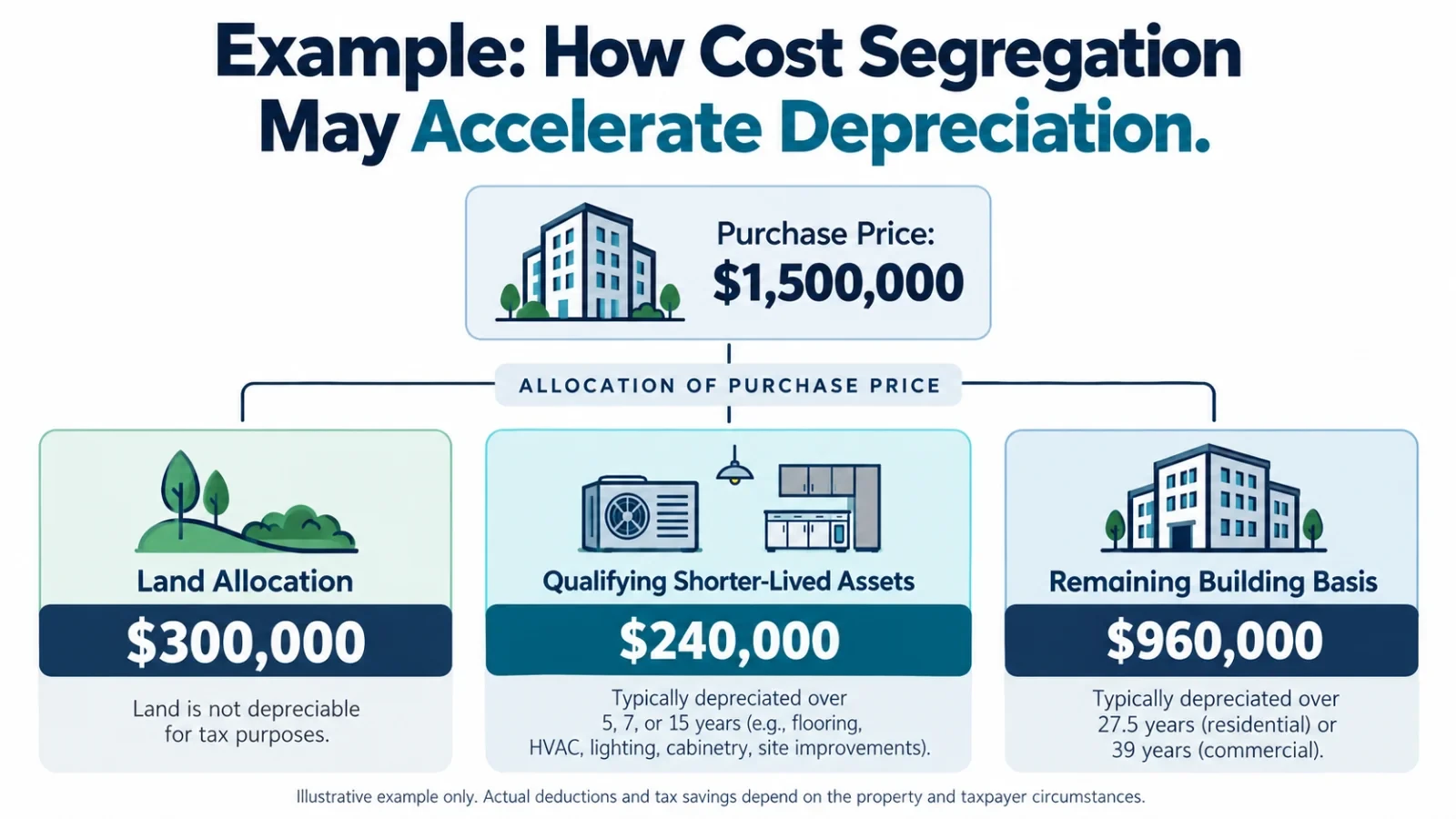
Consider a hypothetical investment property purchased for $1.5 million.
Assume $300,000 is attributable to land, leaving $1.2 million in depreciable basis.
After analyzing the property’s assets, assume a study identifies $240,000 of qualifying shorter-lived property.
If those assets meet the 100% bonus depreciation requirements, the $240,000 could potentially be deducted in the placed-in-service year, in addition to applicable depreciation on the remaining property.
However, that does not mean the study created $240,000 of new deductions or guaranteed a specific amount of tax savings.
Some depreciation would otherwise have been available under the original schedule.
The incremental benefit depends on the timing difference, the taxpayer’s tax rates and whether the accelerated deductions can be used.
The property’s characteristics and individual tax circumstances determine the actual outcome.
The estimate is a starting point. A detailed study is needed to establish actual asset classifications.
What Changed With Bonus Depreciation in 2025?
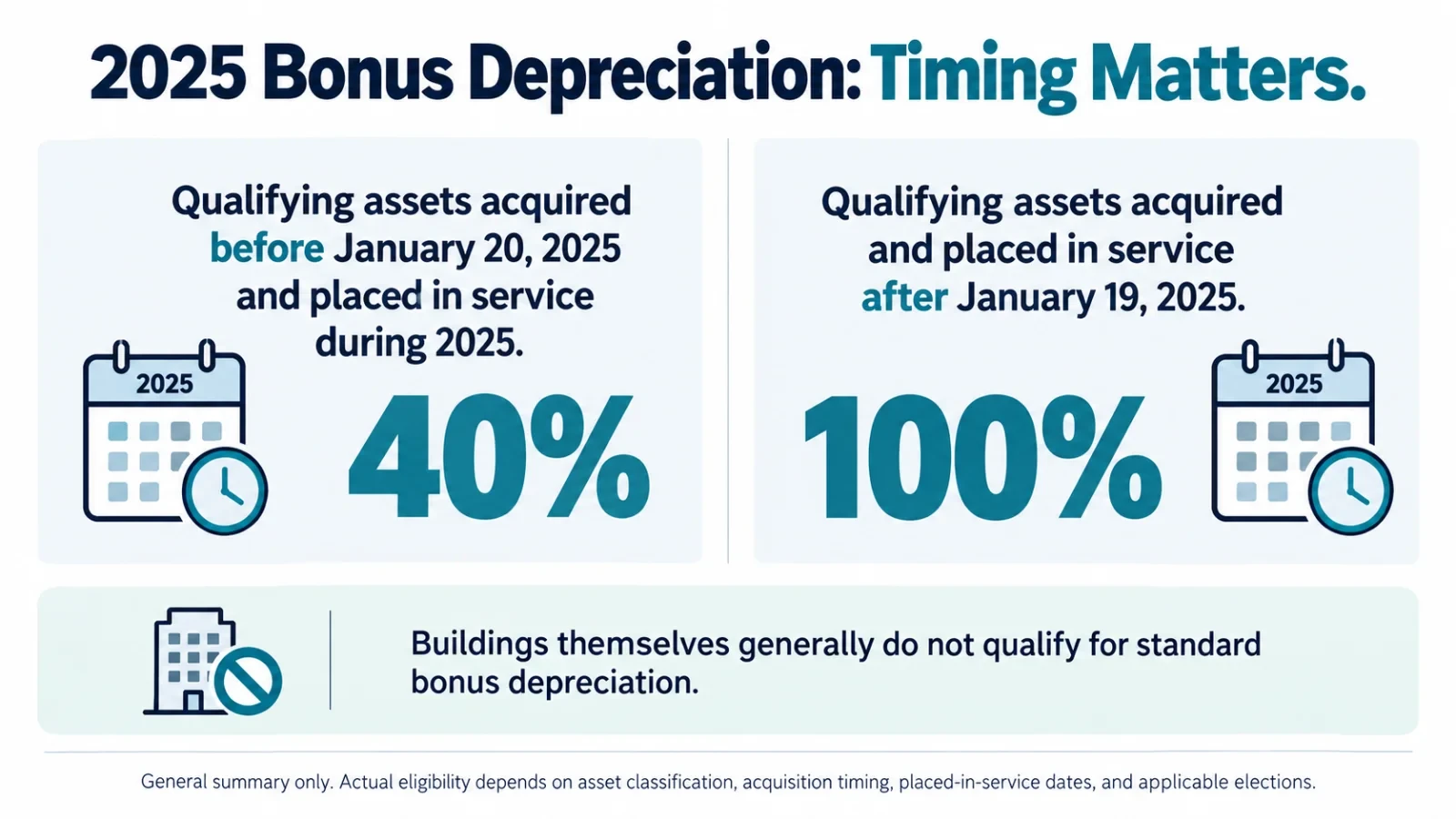
Under federal legislation enacted in July 2025, 100% bonus depreciation was restored for certain qualifying property acquired and placed in service after January 19, 2025.
For certain eligible assets acquired before January 20, 2025 and placed in service during 2025, the generally applicable rate is 40%.
These rules can affect the amount of depreciation available in the first year for qualifying assets.
However, most residential and commercial buildings themselves do not qualify for ordinary bonus depreciation.
Certain shorter-lived assets, including those identified in a cost segregation study, may qualify if the statutory requirements are met.
Your CPA should review the acquisition date, placed-in-service date, asset eligibility and applicable elections.
Source: IRS Publication 946
Can Investment Property Deductions Offset Other Income?
This depends on the activity and the taxpayer.
Rental real estate losses are generally treated as passive under federal tax rules. This can limit whether deductions reduce current taxes on wages or other nonpassive income.
Certain exceptions may apply, such as the special rental real estate loss allowance or treatment available to qualifying real estate professionals who meet the applicable participation requirements.
Other provisions, including basis and at-risk limitations, may also affect deductions.
A large depreciation deduction can be valuable without necessarily reducing the current year’s tax bill by the same amount.
For that reason, property owners should discuss both the amount and usability of projected deductions with their CPAs.
Investment Property Tax Deduction Checklist
Before finalizing your 2025 return, review these questions with your CPA:
- Have qualifying operating expenses been recorded and classified correctly?
- Were repairs distinguished from improvements that must be capitalized?
- Is the allocation between land and depreciable property accurate?
- Are the acquisition and placed-in-service dates correct?
- Have qualifying shorter-lived assets been evaluated?
- Does the property qualify for bonus depreciation?
- Can additional depreciation deductions be used on your current return?
For most individuals with a valid 2025 filing extension, the federal deadline is October 15, 2026. Other taxpayers may have different filing dates.
Frequently Asked Questions
Is Cost Segregation Only for Large Commercial Buildings?
No. Qualifying rental homes, multifamily properties, hotels, retail centers, industrial facilities and other investment properties may be candidates. Financial feasibility depends on the property’s depreciable basis and other factors.
Can I Deduct the Entire Cost of a Rental Building in One Year?
Generally, no. Residential rental buildings typically follow a 27.5-year depreciation schedule, while non-residential buildings generally follow a 39-year schedule. Special provisions and eligible shorter-lived assets can receive different treatment.
Is a Cost Segregation Study Worth Paying For?
It depends on the amount of depreciation that could be accelerated, the study cost, the owner’s tax position and the expected holding period.
A preliminary calculation and property-specific quote can help evaluate whether a study is financially worthwhile.
Find Out What Your Investment Property Could Save
Every property is different. Before deciding whether to pursue a cost segregation study, it helps to understand the potential depreciation opportunity and the estimated study cost.
Calculate Your Potential Tax Savings for Free
Use TDA’s calculator to explore a low-to-high estimate based on your property’s information.
Use the Free Tax Savings Calculator →
Request a Free Cost Segregation Quote
Ready for a property-specific review?
TDA offers a free, no-obligation quote so you can evaluate the potential benefits and cost of an engineering-based study before committing.
Get Your Free Cost Segregation Quote →
Questions about the process? Call 888-790-8595.
Calculator figures are preliminary estimates and do not guarantee deductions or tax savings. Actual outcomes depend on property characteristics, tax rules and the owner’s circumstances.
Tax disclaimer: General information only — not tax, legal or financial advice. Tax outcomes depend on your individual circumstances and property, and any figures shown are illustrative estimates, not guarantees. Speak with your CPA or tax adviser before acting on any of this information.